
When people ask whether polidocanol has FDA approval, the most accurate answer depends on the exact formulation being discussed.
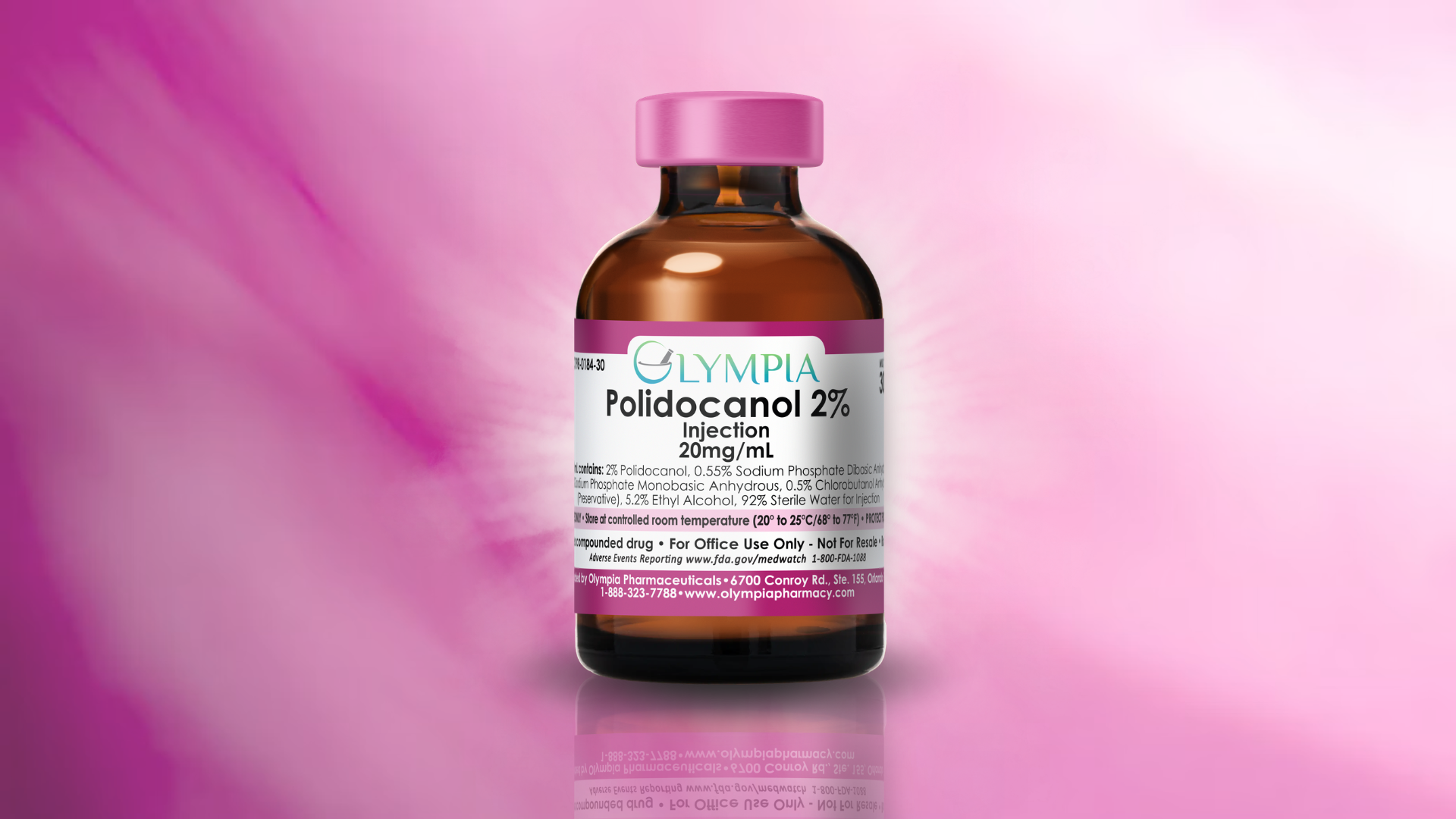
FDA labeling lists an initial U.S. approval date of 2010 for a specific commercial liquid polidocanol injection. That commercial product is available in 0.5% and 1% strengths in 2 mL single-dose ampules. Olympia Pharmaceuticals offers Polidocanol 2% Injection, a compounded prescription product containing 20 mg/mL in a 30mL vial.
These products contain the same active ingredient, but they are not the same finished drug product. Their concentrations, containers, labeling, and regulatory pathways differ.
What Is Polidocanol?
Polidocanol is a nonionic detergent sclerosant used during sclerotherapy procedures. A sclerosant acts on the inner lining of a blood vessel, which is called the endothelium. This sclerosing agent is most commonly used in relation to spider and reticular veins.
Commercial and Compounded Polidocanol Are Different Products
The following comparison highlights the differences between the commercial injection, and our compounded offering.
| Product detail | Commercial injection | Our compounded offering |
| Concentración | 0.5% and 1% | 2%, or 20 mg/mL |
| Container | 2 mL single-dose glass ampule | Liquid 30 mL vial |
| Vía de administración | Intravenous | Intravenous |
| Use setting | Administered as part of a professional sclerotherapy procedure | Vial is labeled for office use only |
| Almacenamiento | 59°F to 86°F | Controlled room temperature and protected from light |
How Polidocanol Works During Sclerotherapy
Sclerotherapy involves placing a sclerosant into a selected vein. Polidocanol begins a local process that closes the vessel.
The process generally involves several steps:
- Polidocanol comes into contact with the vein’s endothelial lining.
- The endothelium is locally damaged.
- Platelets collect at the affected area and attach to the venous wall.
- Platelets, cellular debris, and fibrin form a network that closes the vessel.
- The closed vein is gradually replaced by connective tissue.
Polidocanol should be administered only by a qualified healthcare professional familiar with intravenous injection and sclerotherapy procedures. It is not a product for patient self-administration.
Our Compounded Polidocanol 2% Injection Offering
We offer compounded Polidocanol for licensed healthcare providers incorporating sclerotherapy products into their vein care services.
Polidocanol Precautions
Polidocanol is an injectable prescription product with important precautions. Our product information states that Polidocanol 2% Injection should not be used in patients with:
- A known hypersensitivity or allergy to polidocanol or any product component
- Acute deep vein thrombosis or another acute thromboembolic condition
- Acute superficial thrombophlebitis
- Severe peripheral arterial disease
- An infection or cellulitis at the injection site
- Pregnancy
Providers should review the patient’s medical history and current health status before using a polidocanol product.
How should our Polidocanol 2% Injection be stored?
Store the vial at controlled room temperature and protect it from light. Providers should also follow any storage and handling information supplied with the product.
This information is for educational purposes only and is not intended to substitute for information from a medical provider. Compounded products are not evaluated by the FDA for safety, efficacy, or quality. Consult a medical provider before beginning any new form of care. Rx only.