
Medically reviewed and approved content by Nicole Snow, PharmD
If you’ve been reading about peptides lately, GHK-Cu keeps coming up. It appears in skincare conversations, longevity forums, and increasingly in the questions patients bring to their providers. So what is it, and what does the research actually show?
GHK-Cu is a naturally occurring copper-binding peptide first identified in human plasma in 1973. Researchers have studied it for decades for its role in skin repair and tissue renewal. It’s also getting attention from people on GLP-1 medications who notice their skin looking looser after weight loss. Below, we cover what GHK-Cu is, how it works in the skin, what the evidence does and doesn’t show, why it comes up for skin firmness during GLP-1 weight loss, possible side effects, and how topical GHK-Cu differs from the injectable peptides you may have heard about.
What Is GHK-Cu and Where Does It Come From?
GHK-Cu stands for glycyl-L-histidyl-L-lysine copper complex. It’s a tripeptide, a chain of three amino acids (glycine, histidine, and lysine), bound to a copper ion. In ingredient lists, it often appears as copper tripeptide-1.
The peptide was first isolated from human plasma in 1973. Early research found that it could stimulate cell growth, influence collagen production, and support repair in laboratory and animal models [1]. Collagen, gene signaling, and tissue repair have remained the main threads of GHK-Cu research since.
GHK-Cu is not a hormone or a steroid. It’s a signaling peptide: a short chain of amino acids that helps carry copper to cells and communicates with them about repair and remodeling.
How GHK-Cu Works in the Skin
GHK-Cu’s activity comes down to two things: delivering copper and influencing cell signaling.
Copper is an essential trace mineral. Skin cells rely on it for enzymes involved in building and cross-linking collagen. GHK binds copper tightly and carries it to the cells that use it.
In laboratory studies, GHK-Cu has been shown to [1]:
- Increase collagen and elastin production in human skin cells grown in the lab
- Influence both the enzymes that break down old collagen (matrix metalloproteinases) and the proteins that keep those enzymes in check
- Change the activity of a large number of genes, including ones involved in antioxidant defense and repair
In plain terms, GHK-Cu appears to signal skin cells to build new structural material while regulating how old material is cleared. Most of this evidence comes from cell and animal studies, which is important context for the next section.
GHK-Cu Benefits: What the Research Shows
The potential benefits of GHK-Cu have been studied mostly in skin aging and skin repair. Here is what the research covers, and where it is limited.
- Aging skin. Small clinical studies of facial products containing GHK-Cu have reported improvements in the appearance of wrinkles compared with a control product [1].
- Skin repair. Topical GHK-Cu has been investigated for its role in skin repair, inflammation, and the formation of new blood vessels [2].
- Antioxidant activity. Lab and animal studies suggest GHK-Cu may help protect skin cells from oxidative stress [1].
The limits. A 2026 systematic review found that most GHK-Cu research is preclinical. Of the human studies it identified, only a handful tested GHK-Cu directly; most used it as a comparison product [3]. Larger, well-designed human trials are still needed.
Where improvements have been reported, they build gradually over weeks to months. Copper peptides work with the skin’s own renewal cycle, so consistency matters more than intensity.
GHK-Cu and GLP-1 Weight Loss: Support for Loose Skin on the Face and Neck
GLP-1 medications such as semaglutide and tirzepatide have helped many people lose a significant amount of weight. When weight comes off quickly, though, skin doesn’t always keep pace. Clinicians describe a pattern of facial volume loss and skin laxity after rapid weight loss, which can show up as sagging along the cheeks, jawline, and neck [4].
The reason is structural. Fat that once supported the skin is lost faster than the skin can adjust, and collagen and elastin, the proteins that keep skin firm and springy, can struggle to keep up [4]. Because the face and neck are always on display, that’s often where people notice the change first.
This is where GHK-Cu comes into the conversation. Its most-studied effects line up closely with what loosening skin needs: in lab research, GHK-Cu increases collagen and elastin production and helps regulate how skin rebuilds and remodels itself [1]. For people on a GLP-1, a topical GHK-Cu cream is a way to support skin firmness and texture at home while they work toward their weight goals.
Why some GLP-1 patients add a GHK-Cu cream:
- Collagen and elastin support. GHK-Cu works on the building blocks of firm skin, the same structures that are strained during rapid weight loss.
- Applied where it shows. A topical cream goes directly on the face and neck, where loose or crepey skin tends to be most visible.
- No downtime. It fits into a daily at-home routine, with no procedure or recovery time.
- A matching timeline. GLP-1 weight loss happens over months, and reported GHK-Cu results also build over weeks to months, so it can be started during treatment rather than after.
To set expectations: GHK-Cu hasn’t been studied specifically in people taking GLP-1 medications, and a cream won’t replace lost facial volume the way fillers or procedures can. Its role is supporting skin quality and firmness. Olympia compounds GHK-Cu as Tighten, a prescription cream covered in more detail below, and your provider can help you decide whether it fits your plan.
Can You Use GHK-Cu With Retinol or Tretinoin?
Many people who use a retinoid, such as retinol or prescription tretinoin, are curious about adding a copper peptide. The two work in different ways. Retinoids speed up skin cell turnover, while GHK-Cu delivers copper and signals cells involved in repair and collagen production. That’s why they’re often discussed as complementary rather than competing.
Both can affect sensitive skin, so it’s best not to start them at the same time. Your provider can advise whether to combine them and how to space them in your routine.
Topical vs. Injectable GHK-Cu
GHK-Cu gets a lot of attention online as an injectable peptide. Most of the research on its skin effects, though, involves topical use: creams and serums applied directly to the skin.
Is GHK-Cu available as an injection?
Injectable GHK-Cu has faced FDA restrictions on compounding in recent years, and its status is still under review. Olympia compounds GHK-Cu as a topical cream only.
For someone whose main concern is how their skin looks, a topical product applies GHK-Cu where the research has focused, in a format that fits into a daily routine.
GHK-Cu Side Effects and Precautions
Topical GHK-Cu is generally well tolerated in published studies, but side effects are possible. They can include:
- Redness, irritation, or itching where it’s applied
- Dryness or a stinging sensation, especially at higher concentrations
- Allergic reactions in people sensitive to copper or to other ingredients in the formula
A few precautions:
- Avoid applying it to broken or irritated skin unless your provider directs you to.
- Tell your provider if you’ve recently had a facial procedure, such as a peel, laser treatment, or microneedling, so they can advise on timing.
- Avoid combining it with other strong actives without guidance.
Stop using it and contact your provider if you notice persistent redness, swelling, or itching.
How Olympia Uses GHK-Cu: Tighten for the Face and Neck
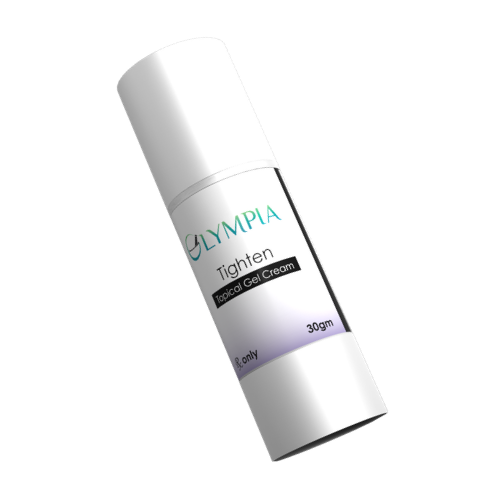
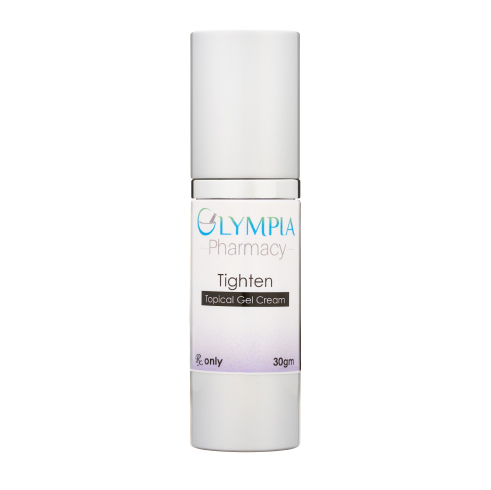
Olympia compounds GHK-Cu into a topical cream called Tighten, available in three strengths: Base (0.5%), Plus (2%), and Max (4%). It’s part of our Dermatology line and is applied at home to the face and neck as directed by your provider.
Many people who ask about Tighten are taking a GLP-1 medication, or have recently finished one, and have noticed their skin looking looser or less firm, especially around the jawline and neck. Tighten gives providers a prescription topical GHK-Cu option to support skin firmness and texture during and after weight loss. With three strengths available, your provider can start at a lower concentration and adjust based on how your skin responds.
Tighten is a compounded medication and requires a prescription. If you use it, follow the directions on your label.
Whether a compounded GHK-Cu cream fits your goals is a conversation for your provider, who can review your skin, history, and priorities. Interested in other peptides? See what Olympia compounds today on our Peptides page, and join our early access list to get updates when new peptides become available.
GHK-Cu FAQs
The Takeaway
GHK-Cu has decades of research behind it, mostly from lab and animal studies, and human evidence is still limited. Its focus on collagen and elastin is why it’s drawing interest from people managing looser skin during GLP-1 weight loss. If a topical, at-home option for your face and neck sounds like a fit, ask your provider whether a compounded GHK-Cu cream belongs in your routine.

Content Reviewed By
This article is for educational purposes only and is not a substitute for advice from a licensed healthcare provider. Compounded medications are not FDA-approved, which means FDA does not review them for safety, effectiveness, or quality before they are dispensed.
Fuentes
- Pickart L, Margolina A. Regenerative and Protective Actions of the GHK-Cu Peptide in the Light of the New Gene Data. International Journal of Molecular Sciences, 2018.
- Adnan SB, et al. Exploring the Role of Tripeptides in Wound Healing and Skin Regeneration: A Comprehensive Review. International Journal of Medical Sciences, 2025.
- Najafi N, Maatouk H, Vardanyan KG, Vartanian KB, Agrawal DK. A Systematic Review of the Mechanisms and Therapeutic Applications of GHK-Cu in Topical Microneedle Delivery: A Case for Expanded Clinical Trials. Archives of Internal Medicine Research, 2026.
- Baggett A, Saadi C, Saadi R, Patel V. Cosmetic Considerations of Semaglutide. Cosmetics, 2025.